
close
Choose Your Site
Global
Social Media


Views: 0 Author: Site Editor Publish Time: 2026-10-24 Origin: Site


Rapid urbanization and the relentless expansion of smart city initiatives have fundamentally shifted how municipalities manage critical infrastructure. As surface-level space becomes increasingly scarce, city planners are forced to move essential services below ground. Underground utility galleries, frequently referred to as utility tunnels, have emerged as the standard engineering solution for housing electrical grids, water mains, natural gas pipelines, and fiber-optic telecommunication networks safely and efficiently.
For engineers and project managers, constructing these subterranean corridors presents a significant technical and financial dilemma: choosing between cast-in-place concrete and precast concrete construction methods. Both approaches carry distinct logistical requirements, cost implications, and structural benefits.
Regardless of the construction methodology selected, the efficiency, safety, and ultimate cost-effectiveness of the project rely heavily on the structural molds used to shape the concrete. The formwork system dictates the structural integrity, dimensional accuracy, and waterproofing capacity of the final tunnel. This guide objectively compares these construction methods, analyzes their respective advantages, and provides an evidence-based framework to help contractors select the optimal equipment for their site conditions.
Cast-in-Place Construction: Provides unmatched structural flexibility for complex, irregular site footprints and creates a seamless, highly waterproof monolithic structure.
Precast Construction: Significantly accelerates the project timeline and ensures strict, factory-level quality control, though it demands heavy lifting equipment and meticulous joint sealing.
Decision Drivers: The optimal choice depends on empirical factors such as site constraints, project budget, timeline requirements, and local soil conditions.
Innovation: Modern engineering solutions, including advanced polymer composite systems, have revolutionized both methods by reducing manual labor costs and maximizing material reusability.
An underground utility gallery is a consolidated, accessible subterranean tunnel system designed to house multiple municipal utility lines. Instead of burying pipes and cables directly in the soil, which necessitates disruptive and costly excavation every time maintenance is required, these galleries allow maintenance personnel to physically walk through the tunnel to inspect, repair, or upgrade infrastructure.
The primary benefits of this system are substantial. It prevents repeated road excavations, often referred to as the zipper effect on urban streets. Furthermore, it shields sensitive utilities from extreme weather events, seismic activity, and soil corrosion, ultimately extending the lifecycle of municipal infrastructure through simplified, proactive maintenance.
The structural integrity of deep underground tunnels relies entirely on properly mixed, poured, and cured concrete. Because these structures bear immense hydrostatic pressure from groundwater and heavy live loads from surface traffic, dimensional precision is non-negotiable. The forming system serves as the structural mold that dictates the strength, shape, and surface finish of the gallery.
High-quality molds ensure proper concrete consolidation, prevent honeycombing, and maintain the exact cover over reinforcing steel. This is essential for long-term corrosion resistance and overall waterproofing capabilities.
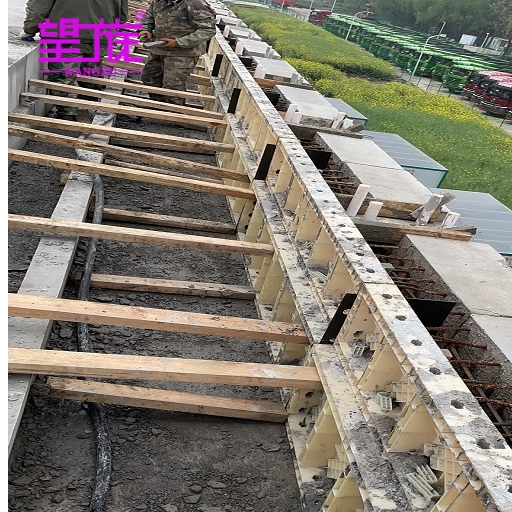
Cast-in-place, or in-situ construction, involves forming and pouring concrete directly at its final installation site within the excavated trench. The process typically begins with deep trench excavation and the installation of heavy-duty shoring systems. Workers then assemble the underground utility gallery formwork along the trench walls, carefully navigating the steel rebar cage. Once the grid is secured and inspected, ready-mix concrete is pumped into the cavity. Crews use mechanical vibrators to eliminate air pockets, ensuring the mixture bonds tightly with the reinforcement. Once the concrete reaches the required compressive strength, the panels are stripped and moved to the next section.
The most significant engineering advantage of in-situ construction is the creation of a monolithic structure. Since there are no joints between segments, the tunnel possesses superior natural waterproofing capabilities, making it ideal for high water table environments. Additionally, this method is highly adaptable to uneven terrain, varying elevations, or unexpected subterranean obstacles. It also minimizes heavy logistics costs, as raw materials are delivered in bulk.
Conversely, the primary drawback is the extended project duration. Cast-in-place construction is highly weather-dependent; extreme temperatures or sudden downpours can delay pouring and curing. It also demands a significant amount of on-site labor for assembly, rebar tying, and concrete finishing.
To mitigate the labor-intensive nature of in-situ construction, contractors are shifting away from heavy steel or traditional timber. Utilizing lightweight, modular systems drastically reduces assembly time. Modern panels are designed for manual handling, feature standardized connection points for rapid deployment, and offer dozens of reuse cycles, effectively lowering the amortized cost per square meter.
Moving beyond the open trench, precast construction shifts the bulk of the concrete work into a controlled factory environment. Concrete tunnel segments are cast indoors using specialized, heavy-duty molds. These segments undergo controlled curing, often using steam to accelerate strength gain, which ensures uniform density and structural integrity.
Once fully cured and quality-tested, these segments are transported via flatbed trucks and carefully lowered into the trench using high-capacity cranes. This process is rapidly gaining favor as urban centers demand faster infrastructure delivery, reflecting a broader industry trend toward off-site prefabrication to minimize traffic disruption.
Precast construction offers exceptionally rapid on-site installation, often cutting open-trench time by more than half compared to cast-in-place methods. Because the segments are manufactured indoors, production remains independent of weather conditions. The factory environment ensures consistent quality, resulting in concrete with precise dimensions.
However, the logistics can be complex and expensive. Transporting massive concrete segments requires specialized permits, pilot vehicles, and clear routing. On-site, the method demands significant heavy-lifting equipment and staging areas, which may be difficult to secure in dense urban centers. Furthermore, the joints between precast segments represent potential waterproofing vulnerabilities, necessitating the use of high-grade gaskets and elastomeric sealants.
When analyzing the financial implications of utility tunnel construction, project managers must weigh capital expenditures against total project duration. Cast-in-place is often more economical regarding raw materials, but the high demand for skilled labor and extended timelines can inflate indirect costs. Precast construction carries steeper upfront manufacturing costs. Yet, the significant reduction in the construction schedule often yields savings, especially on long, standardized routes where overhead and traffic control costs are high.
Current industry data suggests that civil engineering firms are increasingly leaning toward hybrid approaches. While precast is preferred for long, straight runs in greenfield sites, cast-in-place remains the gold standard for navigating the dense, tangled maze of existing underground infrastructure found in older city cores. Industry experts observe that as urban density rises, the demand for formwork that offers both modularity and high-load bearing capacity is becoming the standard for modern utility gallery design.
Quality control presents a trade-off between material consistency and structural continuity. Precast segments benefit from factory-controlled conditions, eliminating variables like humidity and temperature fluctuations. In contrast, cast-in-place structures offer unmatched structural continuity. A jointless pour inherently resists differential settlement better than segmented tunnels, providing long-term durability in unstable or saturated soils.
Engineers should prioritize cast-in-place construction for projects characterized by complex routing, frequent directional changes, and varied elevations. It is highly recommended in areas with high groundwater tables, where the risk of joint failure in precast segments poses a severe threat to internal utilities. It is also the default choice when site access is too restricted for heavy transportation and crane mobilization.
Precast construction is the optimal choice for long, linear stretches of utility tunnels, such as those running alongside new highway developments or in sprawling smart city projects. It is the superior choice when project deadlines are strictly fast-tracked, civic penalties for traffic disruption are significant, and the site offers ample staging space for machinery and storage.
Achieving strict dimensional tolerances is mandatory for underground galleries. Dedicated templates ensure exact dimensions for tunnel walls and haunches, eliminating the guesswork associated with traditional carpentry. Utilizing a highly engineered pipe gallery tunnel template guarantees structural accuracy and a smooth, architectural-grade finish. These templates streamline alignment, significantly reducing the time required for pre-pour inspections and manual adjustments.
The construction industry is rapidly transitioning away from heavy steel and consumable plywood toward advanced polymer composites. Plywood often absorbs moisture and leads to delamination, while steel is prone to rust in damp environments. Contractors are increasingly adopting utility tunnel formwork made from high-density plastics due to its operational efficiency. These systems offer a high reusability quotient, often surviving dozens of cycles without degradation. Because concrete does not adhere strongly to the plastic surface, stripping the panels is effortless. Crucially, these materials are impervious to moisture, ensuring consistent performance in the abrasive conditions typical of deep trench excavations.
Preventing groundwater seepage is the most critical challenge in subterranean construction. For cast-in-place structures, infiltration usually occurs at cold joints—the seams between separate concrete pours. Engineers mitigate this by embedding hydrophilic waterstops into the forms before the pour; these materials expand upon contact with water to create a permanent seal. In precast construction, the challenge lies in the segmental joints, which require the meticulous installation of compressible rubber gaskets and external wraps to form an impenetrable barrier.
When wet concrete is poured into deep forms, it exerts immense outward hydrostatic pressure. If the support system is inadequate, this pressure can cause panels to bow or fail, resulting in structural deformities. Managing this requires a thorough understanding of pour rates and material strength. Contractors must utilize reinforced support systems equipped with calculated tie-rod spacing to safely transfer the load until the concrete sets.
Both construction methods offer distinct advantages tailored to specific project demands. Cast-in-place provides seamless waterproofing and structural flexibility, making it ideal for complex, congested urban environments. Precast construction delivers rapid installation and factory-grade quality, perfect for linear, fast-tracked developments.
The success of either method hinges on the quality of the molds and templates used during the pour. A flawed forming system will compromise the structural integrity of the gallery regardless of where it is produced. By evaluating site conditions, groundwater levels, and project timelines carefully, construction teams can leverage modern modular plastic systems and precision templates to streamline their next infrastructure project.
While heavy steel and plywood are traditional choices, high-density plastic modular systems are becoming the industry standard. They are favored due to their lightweight handling, exceptional reusability, and absolute resistance to the water and corrosion typically found in damp subterranean environments.
The concrete segments themselves are highly dense and impermeable. However, the joints between segments are vulnerable. They require meticulous engineering and sealing with specialized compressible gaskets and external sealants to prevent infiltration. Cast-in-place structures are monolithic and naturally more watertight as they lack these periodic seams.
A dedicated tunnel template provides a pre-engineered, standardized structural mold. This drastically reduces the labor hours required for measuring, cutting, and assembling custom timber frames. It ensures precise, repeatable dimensions, thereby accelerating the entire pouring cycle and minimizing the risk of dimensional errors that lead to rework.
Yes, provided you select an adaptable system. Universal plastic panels and modular systems are specifically designed to be reconfigured for various tunnel dimensions and wall thicknesses. Because they can be reused dozens of times, they offer an excellent return on investment across multiple infrastructure projects.
The overall cost depends on the scope and site conditions. Cast-in-place generally features lower material and transportation costs but incurs higher on-site labor expenses. Precast construction involves high upfront manufacturing and crane mobilization costs but often saves money indirectly by significantly shortening the overall construction schedule. For assistance in selecting the right equipment for your specific utility project, contact our team for a tailored solution.


